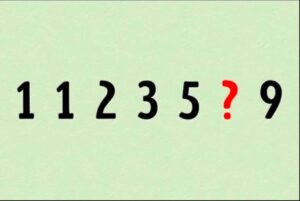
Dr. Emma Chen’s viral math puzzle has ignited global intrigue, as minds everywhere attempt to uncover the elusive missing number in sequences that seem simple at first glance but hide unexpected complexity. Numbers like 2, 5, 11, 23 and 3, 7, 13, 25 have sparked lively debates, with theories ranging from arithmetic progressions to prime-based logic. This challenge has become more than just a brain teaser; it now bridges casual solvers and devoted mathematicians alike, each drawn in by the shared excitement of cracking the code.
The appeal of Dr. Chen’s creation lies in how it brings together experts and amateurs, all searching for that clever twist or unique insight that will reveal the solution. Across classrooms, online forums, and research labs, the hunt for the missing number is fueling new ideas in pattern recognition and challenging even seasoned problem-solvers. What makes this particular puzzle such a true test of ingenuity?
What makes this math puzzle so intriguing?
The influence of Dr. Chen’s puzzle extends far beyond what might be expected from an ordinary IQ test. Teachers, researchers, and passionate learners keep returning to these number series not only for entertainment but also because solving them develops essential analytical skills.
This riddle is more than just an exercise; each sequence opens doors to fresh learning opportunities and sparks discussion about how mathematical patterns are discovered and interpreted in real time.
How does the missing number inspire worldwide collaboration?
On every continent, digital communities have come together to tackle these perplexing strings of numbers. Interactive threads quickly fill with suggestions and counter-arguments, fueling dynamic debate about whether the answer lies in arithmetic, prime-based logic, or entirely new algorithms. Researchers across disciplines use this logic puzzle as a testing ground for advanced machine learning models and enhanced pattern recognition.
This international phenomenon stretches into academia as well. Educators incorporate the challenge into their lessons, giving students a modern and engaging way to practice unconventional reasoning. The quest for the missing number becomes a powerful tool for collaborative thinking, inspiring learners to compare strategies and refine their problem-solving approaches.
What sets Dr. Chen’s puzzle apart from ordinary math challenges?
Unlike typical textbook examples, these number series encourage participants to question assumptions and push past obvious solutions. Each progression draws solvers in with seemingly familiar patterns, only to introduce twists that demand adaptive thinking. While identifying initial trends may feel straightforward, truly solving the puzzle requires recognizing the subtle shifts that follow.
The puzzle challenge rewards persistence and creativity over rote memorization. The longer one examines the tangled numbers, the greater the temptation to unravel their hidden rhythm—and perhaps demonstrate authentic genius when the final answer emerges.
How are people trying to solve the puzzle?
Those taking on Dr. Chen’s challenge dive deep, exploring everything from advanced equations to creative guesswork. No single method guarantees success, making flexibility and open-mindedness key traits for any solver.
Some of the most inventive strategies include:
- Testing straightforward arithmetic or multiplication patterns
- Exploring relationships involving squares, cubes, or factorials
- Investigating links to famous patterns, such as Fibonacci or prime numbers
- Using computer programs to search for hidden algorithms within the number series
- Drawing visual diagrams to analyze growth rates and predict possible next numbers
Debate continues over which approach will finally unlock the correct missing number. Dr. Chen’s thoughtful design ensures that each sequence offers its own distinct test, balancing accessibility with genuine complexity.
Why do experts believe only a genius can truly solve these sequences?
Each set of numbers entices the mind with apparent simplicity, yet beneath the surface lie subtle jumps and patterns that defy traditional techniques. Some experts suggest that finding the right answer requires abstract thinking and the ability to spot connections invisible to those relying solely on formulas.
Others argue that a true breakthrough often comes from intuitive leaps—a spark of inspiration that only rare individuals experience. This unpredictability makes the journey both demanding and deeply rewarding, offering satisfaction beyond theoretical achievement for anyone who masters advanced pattern recognition.
Where does AI fit in the world of complex puzzles?
As academic teams form around the globe, artificial intelligence plays an increasingly important role in decoding Dr. Chen’s ingenious riddles. Powerful algorithms simulate countless possibilities, searching for non-linear correlations hidden within each number series.
This evolving competition between human intuition and computational power raises questions about the nature of genius: Is the solution best left to lightning-fast machines, or does it belong to unpredictable human creativity?
How has the puzzle influenced education and research?
Classrooms now buzz with energy as instructors turn the math puzzle into hands-on activities. Students hone analytical abilities while connecting mathematics to practical applications in coding, cryptography, and data science. The viral status of Dr. Chen’s creation proves how a single idea can reinvigorate lesson plans and engage learners at every level.
Meanwhile, universities see researchers examining how humans and machines collaborate on complex problem-solving. Institutional competitions heighten excitement and drive innovation in fields like neural networks and cognitive modeling. Even small victories—such as predicting the next number—add valuable insights to broader projects in logic and artificial intelligence.
Will anyone ever solve the ultimate missing number?
Uncertainty fuels ongoing fascination. Some believe the answer will emerge from collaboration between expert solvers and AI specialists, while others hope for a lone genius to crack the code through sheer instinct and perseverance.
For now, Dr. Chen’s viral math puzzle reminds everyone why pattern recognition remains eternally captivating. Whether it is teachers building lessons, engineers testing hypotheses, or everyday fans swapping theories, all paths lead back to the mysterious missing number waiting to be found.